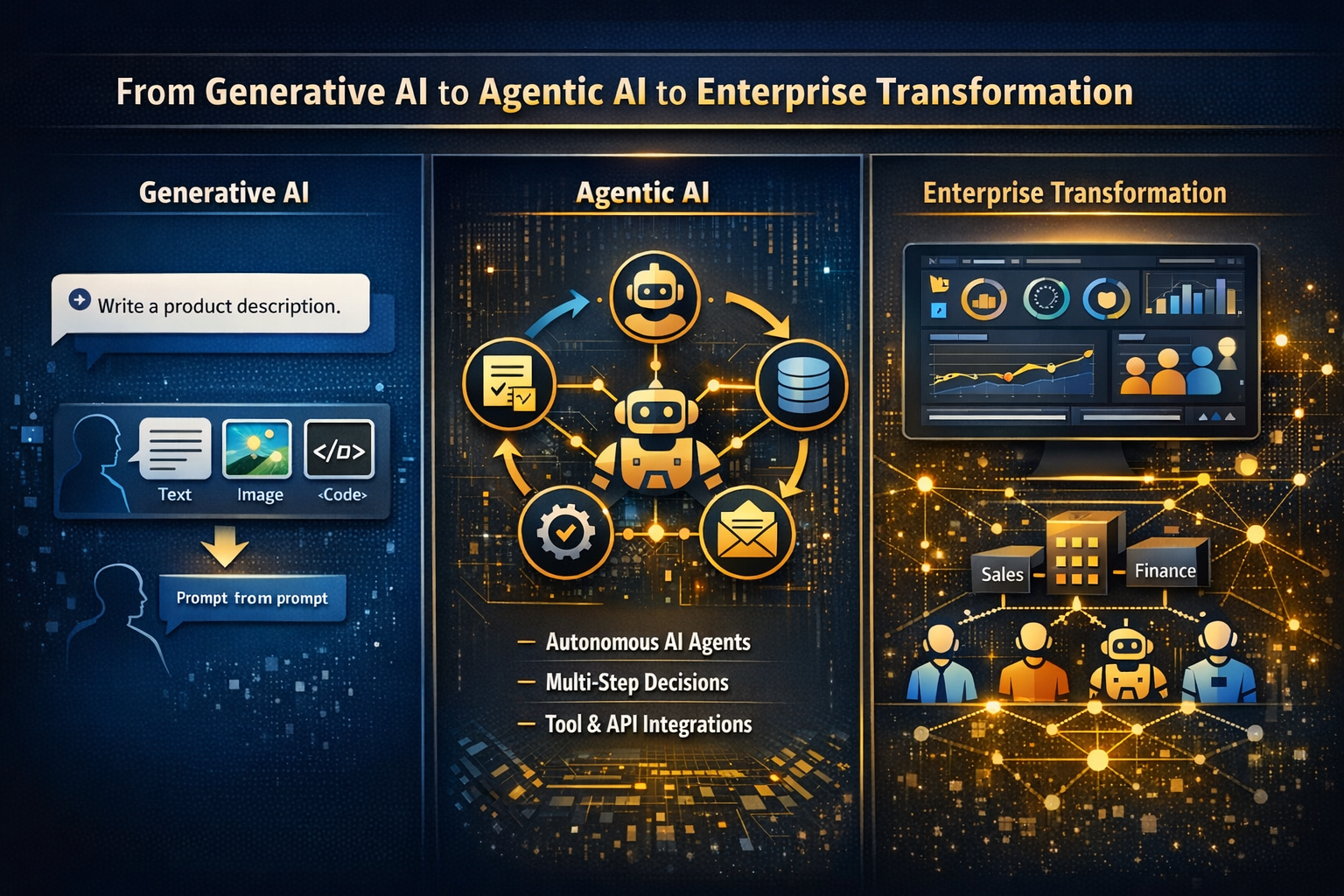
For much of the past two years, enterprise conversations about artificial intelligence have been dominated by copilots, chat interfaces, and productivity tools. These innovations have delivered real benefits—faster content creation, improved search, and incremental gains in developer and knowledge-worker efficiency. Yet despite the attention, very few organizations can point to sustained, P&L-level impact from generative AI alone.
What is now emerging, across nearly every major research institution and consulting firm, is a much more consequential shift. The next phase of enterprise AI is not about assisting humans with isolated tasks. It is about building systems that can autonomously plan, decide, act, and adapt within clearly defined boundaries. This transition—from Generative AI to Agentic AI—represents not just a technological evolution, but a fundamental redesign of how enterprises operate.
After reviewing recent research from McKinsey and QuantumBlack, AWS, PwC, Accenture, Bain, IBM, BCG, and Deloitte, a striking level of consensus appears. The firms differ in language and emphasis, but they converge on one central insight: the real value of AI will come when autonomous agents are embedded directly into end-to-end business processes, not layered on top of them.
The Limits of Copilots
The period from roughly 2022 to 2024 is often called the “copilot era.” During this phase, enterprises experimented with AI systems that responded to prompts, generated outputs, and supported human decision-making. These tools were valuable, but inherently reactive. They waited for instructions. They lacked memory, agency, and accountability. Most importantly, they did not own outcomes.
Agentic AI changes this relationship entirely. An agentic system is designed to pursue a goal rather than answer a question. It can decompose that goal into a series of steps, decide which tools or applications to invoke, evaluate the results of its actions, and adjust its behaviour over time. Where copilots assist, agents operate. Where copilots enhance productivity, agents reshape workflows.
This distinction matters because enterprises are not collections of isolated tasks. They are networks of interdependent processes—customer onboarding, order fulfillment, incident management, financial close, and supply chain planning—each spanning multiple systems, teams, and decision points. Productivity tools can help individuals move faster, but they do not fundamentally change how these systems function. Agentic AI does.
Where Enterprises Actually Stand Today
Despite the growing excitement, most organizations are still in the early stages of this transition. Research consistently shows that while experimentation with generative AI is widespread, meaningful financial impact remains limited to a small group of leaders. The gap is not driven by model capability. Today’s models are already powerful enough to support many agentic use cases. The real constraints lie elsewhere.
Enterprises struggle with fragmented data landscapes, accumulated technical debt, and unclear ownership for AI initiatives. Governance models are often immature, oscillating between over-control that stifles progress and under-control that introduces unacceptable risk. Skills gaps persist across engineering, product, operations, and risk functions. As a result, many AI initiatives stall at the pilot stage, impressive in demonstration but disconnected from core operations.
At the same time, a smaller group of organizations is moving ahead more quietly. These companies are deploying semi-autonomous agents in customer service, IT operations, finance, and supply chain workflows. They are not attempting full autonomy everywhere. Instead, they are redesigning specific processes to have agents handle routine cases while escalating exceptions to humans. This pragmatic approach is where an early, durable advantage is being built.
Where Agentic AI Creates Enterprise Value
Across the research, four value domains consistently emerge as the most fertile ground for agentic systems. In customer-facing functions, autonomous agents are increasingly handling service requests, personalizing interactions, and supporting multi-step sales and onboarding journeys. The impact is not just lower cost, but improved customer experience through faster resolution and greater consistency.
In operations and supply chain functions, agentic systems excel at managing “happy path” scenarios at scale. They clear routine transactions, monitor for anomalies, and intelligently escalate exceptions. This reduces cycle times, lowers error rates, and frees human teams to focus on higher-value judgment calls rather than constant triage.
Within IT and engineering, agentic AI is already reshaping how incidents are detected, diagnosed, and resolved. Agents can correlate signals across logs, metrics, and tickets, propose fixes, and in some cases execute them automatically. The result is improved uptime, faster mean time to resolution, and a significant reduction in operational toil.
Finally, in knowledge-intensive environments, agentic systems act as connective tissue across fragmented information. They continuously classify, summarize, route, and contextualize knowledge, enabling better decisions and scaling expertise beyond individual contributors.
The Foundation Most Organizations Underestimate
One of the clearest warnings across all ten reports is that agentic AI cannot succeed without a strong underlying foundation. Autonomous agents are only as effective as the systems they can observe and influence. Broken data, brittle integrations, and opaque governance do not merely slow progress—they make autonomy unsafe.
At a minimum, enterprises need a coherent agent orchestration layer that separates planning, execution, and evaluation. They need robust integration into core systems such as ERP, CRM, and industry platforms. They need unified data and knowledge layers that agents can reason over reliably. They need strong identity, access management, observability, and auditability to ensure trust and compliance.
The message from Bain, IBM, and McKinsey is unambiguous: organizations that try to “bolt on” agentic AI without addressing foundational architecture will remain stuck in perpetual experimentation.
A New Operating Model Emerges
As agents take on more responsibility, enterprises are being forced to rethink how work is organized and governed. Traditional project-based delivery models are poorly suited to systems that operate continuously and improve over time. In response, leading organizations are experimenting with new operating constructs.
Cross-functional AI pods bring together engineering, product, operations, risk, and domain expertise around specific agent-driven workflows. New roles are emerging, including agent owners accountable for outcomes, AI product managers focused on value realization, and safety leads responsible for guardrails and escalation design. Autonomy is introduced gradually, moving from recommendation to supervised execution to fully autonomous operation as confidence grows.
A recurring insight across McKinsey, BCG, IBM, and Deloitte is that governance must be designed into the system rather than layered on afterward. Audit logs, risk tiers, human-in-the-loop controls, and clear escalation paths are not obstacles to scale; they are prerequisites for it.
Where the ROI Really Comes From
One of the most valuable contributions of the recent research is its clarity on financial outcomes. Across Accenture, PwC, Bain, and McKinsey, the same pattern appears. Sustainable ROI from agentic AI does not come from isolated productivity gains. It comes from redesigning entire processes.
Cost reduction follows when repetitive work and manual escalation are automated end-to-end. Throughput improves when cycle times shrink, and handoffs disappear. Growth accelerates when customer journeys become faster, more personalized, and more reliable. Risk and quality improve when decisions are consistent, auditable, and governed by design.
The organizations that struggle are those that deploy agents as point solutions rather than re-architecting workflows around them. The organizations that succeed treat agents as core operational actors.
Looking Toward 2028
Looking ahead to the latter part of this decade, the research paints a clear picture. By 2028, many routine enterprise operations will run on semi- or fully autonomous agents. Humans will shift toward defining goals, setting constraints, and managing exceptions rather than executing every step. IT functions will increasingly resemble automation and agent platforms rather than traditional service organizations.
In this future, early adopters will enjoy structural advantages that compound over time. Lower cost structures, faster response times, and greater operational resilience will not be easily replicated by laggards. Agentic AI will cease to be a differentiator and become table stakes.
The Larger Implication
The most important takeaway from synthesizing these reports is that agentic AI is not an AI strategy. It is an enterprise transformation strategy. It forces leaders to confront long-standing issues around data, integration, governance, and operating models that were previously tolerated but rarely addressed.
Organizations that treat agentic AI as another technology trend will be disappointed. Those who recognize it as a catalyst for rethinking how work gets done will define the next generation of enterprise performance.
The shift is already underway. The question is not whether it will happen, but who will lead it.
Sources and Further Reading
QuantumBlack / McKinsey – The State of AI in 2025
https://lnkd.in/dF-bJp_X
AWS – The Rise of Autonomous Agents
https://lnkd.in/dz4mMQ6J
PwC – Agentic AI: The New Frontier in GenAI
https://lnkd.in/di2bK7FW
McKinsey – The Agentic AI Opportunity
https://lnkd.in/dGtWpXuU
Accenture – Six Insights to Maximize the ROI of Agentic AI
https://lnkd.in/dHvdGUX7
Bain – Building the Foundation for Agentic AI
https://lnkd.in/djrrncS6
IBM – Agentic AI’s Strategic Ascent
https://lnkd.in/dK5tRk5T
BCG – The Emerging Agentic Enterprise
https://lnkd.in/dHAFffSu
McKinsey – The Agentic Organization
https://lnkd.in/dt_AyUTkDeloitte – Agentic Enterprise 2028
https://lnkd.in/dr64V72F
